
What you get for ten cents
The CH32V003 is built around a 32-bit RISC-V core (the "QingKe" RV32EC) running at up to 48 MHz. A typical part offers roughly 16 KB of flash and 2 KB of RAM, plus the peripherals you actually use day to day: GPIO, timers, a fast ADC, and serial interfaces such as USART, SPI, and I²C. It ships in several packages, from a tiny SOP-8 up to a more breadboard-friendly TSSOP-20.
For comparison, that is a 32-bit core at a price that used to buy you a far more limited 8-bit part. For small automation, sensors, and learning projects, the value is hard to beat.
Why I made breakout boards
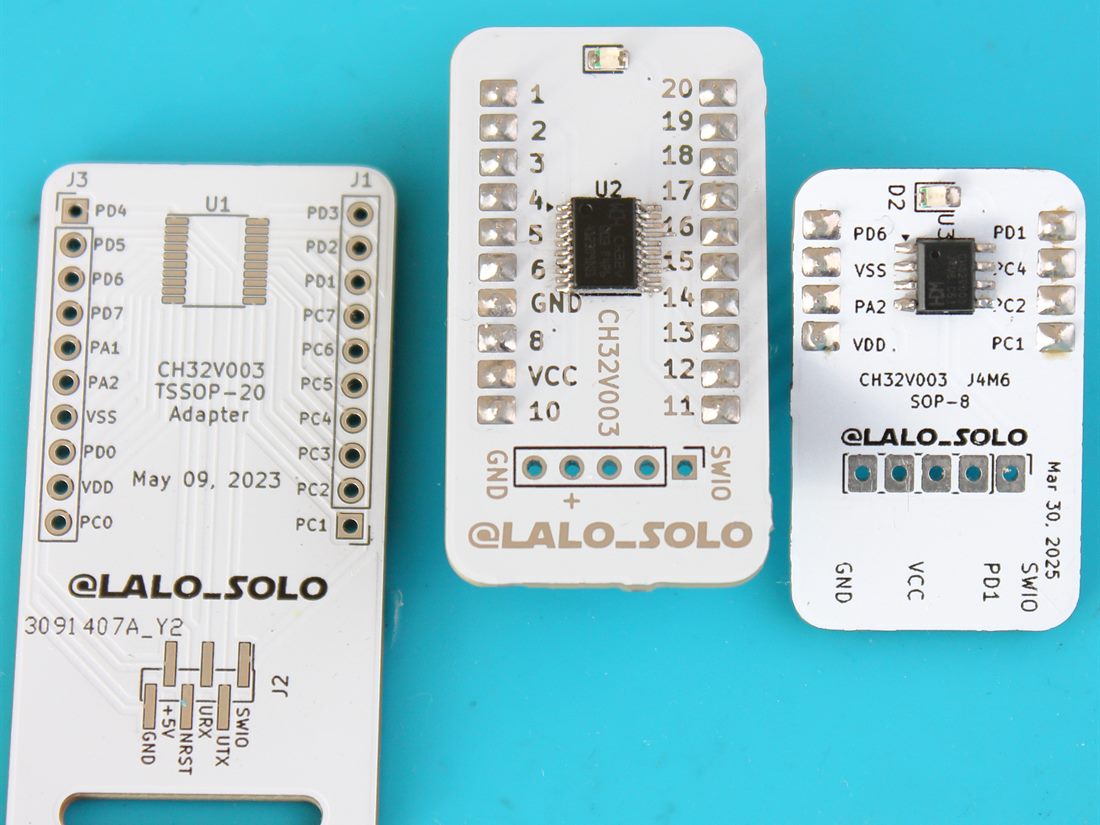
The catch with a part this cheap is that it only comes in surface-mount packages — there is no through-hole version to drop into a breadboard. So I designed small adapter PCBs in KiCad that break each package out to a standard 0.1-inch pin header, including the SWIO programming pin and decoupling close to the supply pins. That turns a fiddly SMD chip into something you can prototype with directly.
Programming it
The CH32V003 is programmed over a single-wire debug interface (SWIO) using an inexpensive WCH-LinkE programmer. You have a few good options for the toolchain:
- The official MounRiver Studio IDE, which bundles the RISC-V GCC toolchain and WCH's libraries.
- The open-source ch32v003fun framework, a minimal, fast-to-flash environment popular in the community.
- An Arduino-style setup, if you prefer that ecosystem and its libraries.
Whichever you choose, the classic first program is the same: blink an LED. It confirms your toolchain, programmer wiring, and the board all work before you build anything more ambitious.
A part this cheap changes how you think about projects. You stop rationing microcontrollers and start using one wherever it helps.
Where it shines — and where it doesn't
With 2 KB of RAM, the CH32V003 is not the chip for graphics-heavy displays or large buffers. It is perfect, though, for the enormous category of jobs that need a little intelligence cheaply: reading a sensor, driving a few outputs, debouncing buttons, blinking status LEDs, or handling simple serial communication. Match the chip to the job and it is a joy.
A good on-ramp to RISC-V
Beyond the price, the CH32V003 is a low-stakes way to get hands-on with the RISC-V architecture that is reshaping the industry. You learn a modern instruction set on hardware that costs almost nothing to replace if you let the magic smoke out.
Start with a breakout board and a WCH-LinkE programmer. Get an LED blinking first; every other project builds on that working baseline.